
PABELLÓN
Shredded beef, black beans, plantains, and cheese.

REINA PEPIADA
A classic: chicken, avocado, and mayo.
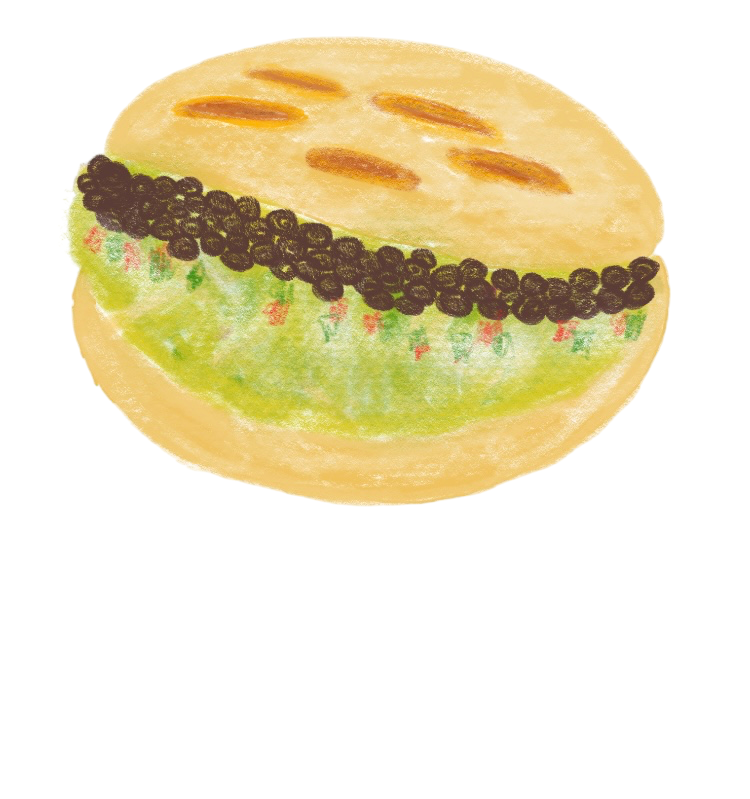
COLEADA
A vegan arepa that only exists in Berlin: black beans, plantains, avocado, tomato and salsa.
a flat, round, and grilled cornmeal cake, usually sliced open and served with various fillings.
Shredded beef, black beans, plantains, and cheese.
A classic: chicken, avocado, and mayo.
A vegan arepa that only exists in Berlin: black beans, plantains, avocado, tomato and salsa.


Rubens Arepas is a Venezuelan food spot in Berlin that brings the comfort, warmth, and flavor of arepas into the city’s street food scene.
For this project, I wanted to highlight the arepa as something tied to culture, memory, migration, and community.
For this project, I interviewed Ruben, the chef and owner of Rubens Arepas in Berlin, as part of an exploration into food, migration, and cultural memory in the Venezuelan diaspora. Through his story, I wanted to understand how traditional dishes transform when they move across borders, and how food becomes a way of carrying home while also adapting to new places.
We spoke about his earliest memories of eating arepas, learning to cook from his mother, and how the arepa represents culture, tradition, and everyday life. The conversation also reflects on diaspora experience in Berlin: how ingredients shift, how flavors evolve, and how food can become a shared space between Latin American communities and beyond.
Q: ¿Cuál es tu primer recuerdo comiendo arepas?
“Comiendo en casa de vecinos desde niño… la señora las hacía muy ricas. ‘Mamá, él quiere otra’.”
Eating at neighbors’ houses as a child… the woman would make them really well. “Mom, he wants another one.”
Q: ¿Cómo aprendiste a cocinar arepas?
“Aprendí desde niño, observando y ayudando a mi mamá. Uno crece con eso.”
I learned from a young age by watching and helping my mother. You grow up with it.
Q: ¿Te sientes más conectado con tu cultura a través de tu restaurante?
“Yo me siento mucho más conectado con la gente de Venezuela, con mi cultura, y con los latinos en general. La comida les recuerda un poco a sus países, incluso a personas de Brasil o Costa Rica. Es una conexión con muchas culturas al mismo tiempo..”
I feel much more connected to people from Venezuela, to my culture, and to Latin people in general. The food reminds people of their home countries, even people from places like Brazil or Costa Rica. It creates a connection across many cultures at the same time.”
Q: ¿Cocinar comida venezolana aquí ha cambiado ?
““Me hacía arepitas con queso. Pero fue aquí en Berlín donde empecé a cocinar comida venezolana, primero para mis amigos. Ahí fue cuando realmente comenzó mi experiencia con la comida venezolana, cuando empecé a cocinarla yo mismo.”
I used to make simple arepas with cheese. But it was here in Berlin that I started cooking Venezuelan food, first for my friends. That’s when my experience with Venezuelan food really began, when I started cooking it myself.
Q: ¿Hubo algún momento en el que te diste cuenta de que esto ya no era igual que en casa?
“No he tenido esa sensación de que ya no sea como en casa. Aquí en Berlín he querido transmitir eso — estar como en casa, dar un pedacito de Venezuela y de Latinoamérica. Algunas de mis recetas las he variado, por ejemplo con un toque de República Dominicana, como ponerle limón. He ido cambiando las recetas, integrando diferentes culturas.”
“I haven’t really felt like it’s no longer like home. Here in Berlin, I’ve tried to recreate that feeling, to feel at home, to give a small piece of Venezuela and Latin America. Some of my recipes have changed, for example adding a Dominican touch, like using lime. I’ve adapted my recipes over time, integrating different cultures.”
Q: ¿Cuál fue el ingrediente más difícil de conseguir cuando llegaste aquí?
"He tenido que adaptar ingredientes y sabores. A veces no encuentro lo mismo de Venezuela, como el ají dulce, así que busco alternativas como el pimentón. Pero también he integrado influencias de otros lugares, como República Dominicana o la cocina local. Es una mezcla que sigue evolucionando."
I’ve had to adapt ingredients and flavors. Sometimes I can’t find the same things from Venezuela, like ají dulce, so I look for alternatives like bell pepper. I’ve also integrated influences from other places, like the Dominican Republic and local cuisine. It’s a mixture that keeps evolving.
Q: ¿Cómo reaccionan los clientes a tu comida?
“Algunos venezolanos se sorprenden, otros aman el sabor. Los alemanes están felices y curiosos.”
Some Venezuelans are surprised, others love the flavor. German customers are happy and curious.
Q: ¿Cómo han cambiado tus arepas desde que estás en la diáspora?
“La arepa ha cambiado porque también cambia el contexto en el que existe. Por ejemplo, la arepa coleada es vegana, y eso no existe en Venezuela, nace aquí, en Berlín. Eso demuestra que la comida no es algo fijo, sino algo que evoluciona con las personas, con los ingredientes disponibles y con el entorno. En la diáspora, uno no solo reproduce lo que hacía antes, sino que lo adapta, lo transforma y lo mezcla con otras influencias. Pero ese cambio no significa perder la esencia. Al contrario, es una forma de mantener la cultura viva. La arepa sigue siendo arepa, pero ahora cuenta otra historia, una historia de migración y de mezcla.”
The arepa has changed because the context around it has changed. For example, the arepa coleada is vegan and that doesn’t exist in Venezuela. It was created here, in Berlin. That shows that food is not something fixed, but something that evolves with people, with available ingredients, and with its environment. In the diaspora, you’re not just reproducing what existed before, you’re adapting it, transforming it, and mixing it with other influences. But that change doesn’t mean losing its essence. If anything, it’s a way of keeping the culture alive. The arepa is still an arepa, but now it tells a different story, one of migration and blending.”
Q: ¿Sientes que estás preservando la cultura venezolana a través de tu comida, o transformándola?
“No es solo preservar o transformar, es hacer las dos cosas al mismo tiempo. Por un lado, hay una intención de preservar la cultura, de mantener los sabores, las técnicas y la memoria de lo que significa la comida venezolana. Pero al mismo tiempo, al estar en otro lugar, esa comida inevitablemente cambia. Entonces no se trata de una pérdida, sino de una evolución. La cultura no se queda congelada, se adapta, crece y se redefine dependiendo de dónde estamos y con quién estamos. En ese sentido, siento que estoy representando la cultura, pero también contribuyendo a su transformación."
It’s not just about preserving or transforming, it’s both at the same time. On one hand, there’s an intention to preserve the culture, to keep the flavors, the techniques, and the memory of what Venezuelan food means. But at the same time, being in a different place means that the food inevitably changes. So it’s not a loss, but an evolution. Culture doesn’t stay frozen, rather it adapts, grows, and redefines itself depending on where we are and who we’re with. In that sense, I feel like I’m representing the culture, but also contributing to its transformation.